Training science
Why 2D Dry Fire Training Beats 3D Simulators for Pistol Skill
By Matt Burkett · Published · Updated · 4 min read
Short answer
For the core pistol skills (draw, sight picture, trigger press, transitions and reloads), a clean 2D target drawn at true size trains as well as or better than a busy 3D scene. Research on simulator fidelity finds simpler simulators usually match realistic ones for skill transfer, and extra visual detail adds mental load that slows learning. 3D earns its place for movement and judgment scenarios.
Key takeaways
- Most pistol skills are visual-motor: see the target, get the sights on it, press without disturbing them, move on. None of that needs scenery.
- In randomized studies of procedure training, low-fidelity simulators were not inferior to high-fidelity ones in 15 of 17 studies.
- Extra visual detail is "extraneous load" in cognitive load theory. Beginners are hit hardest.
- True size beats realism. A target only trains your eyes if it's the right size for your screen and viewing distance.
- 3D helps for moving through depth, scenarios and judgment calls, and possibly for already-skilled shooters.
What's the difference between 2D and 3D dry fire training?
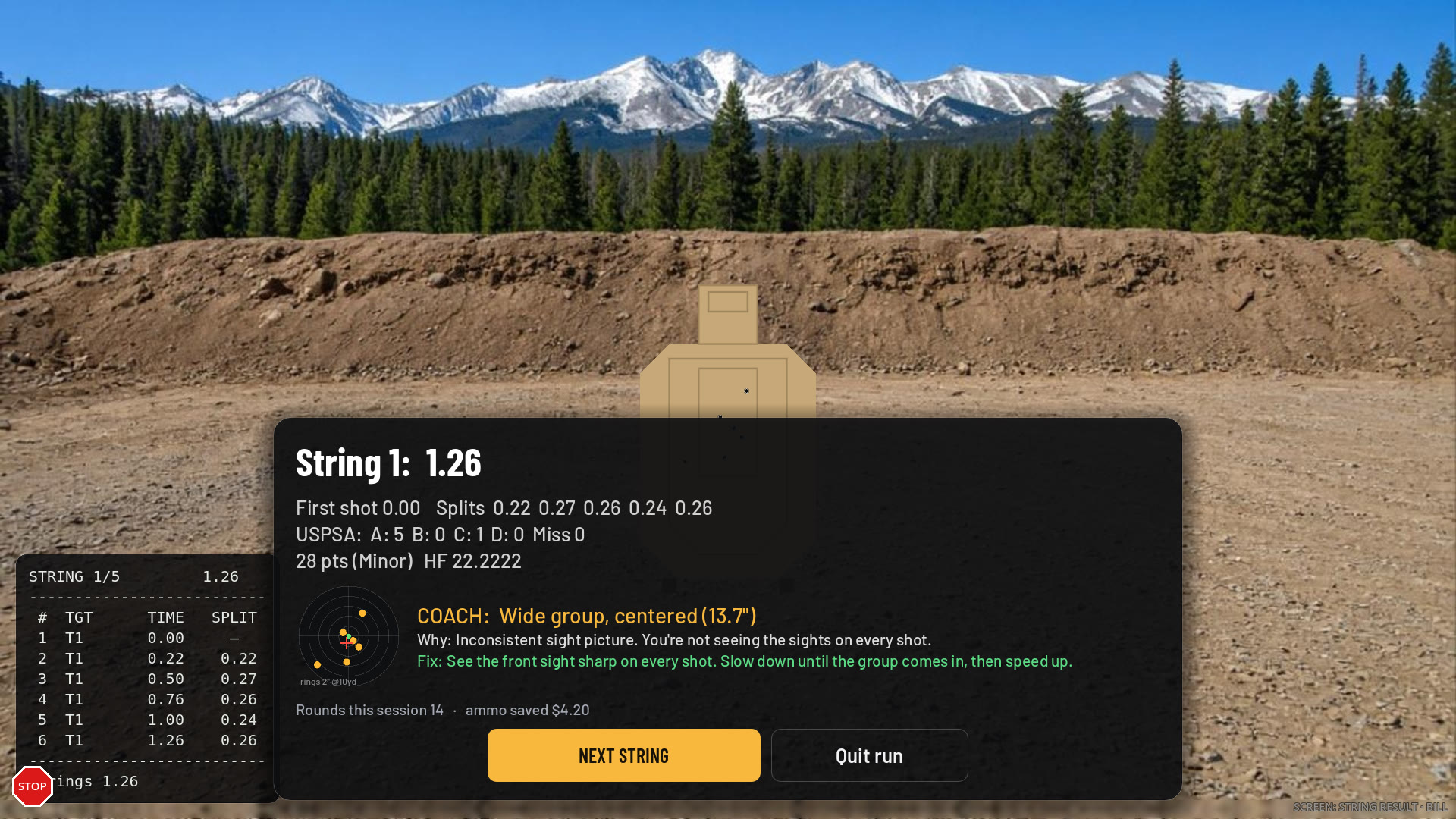
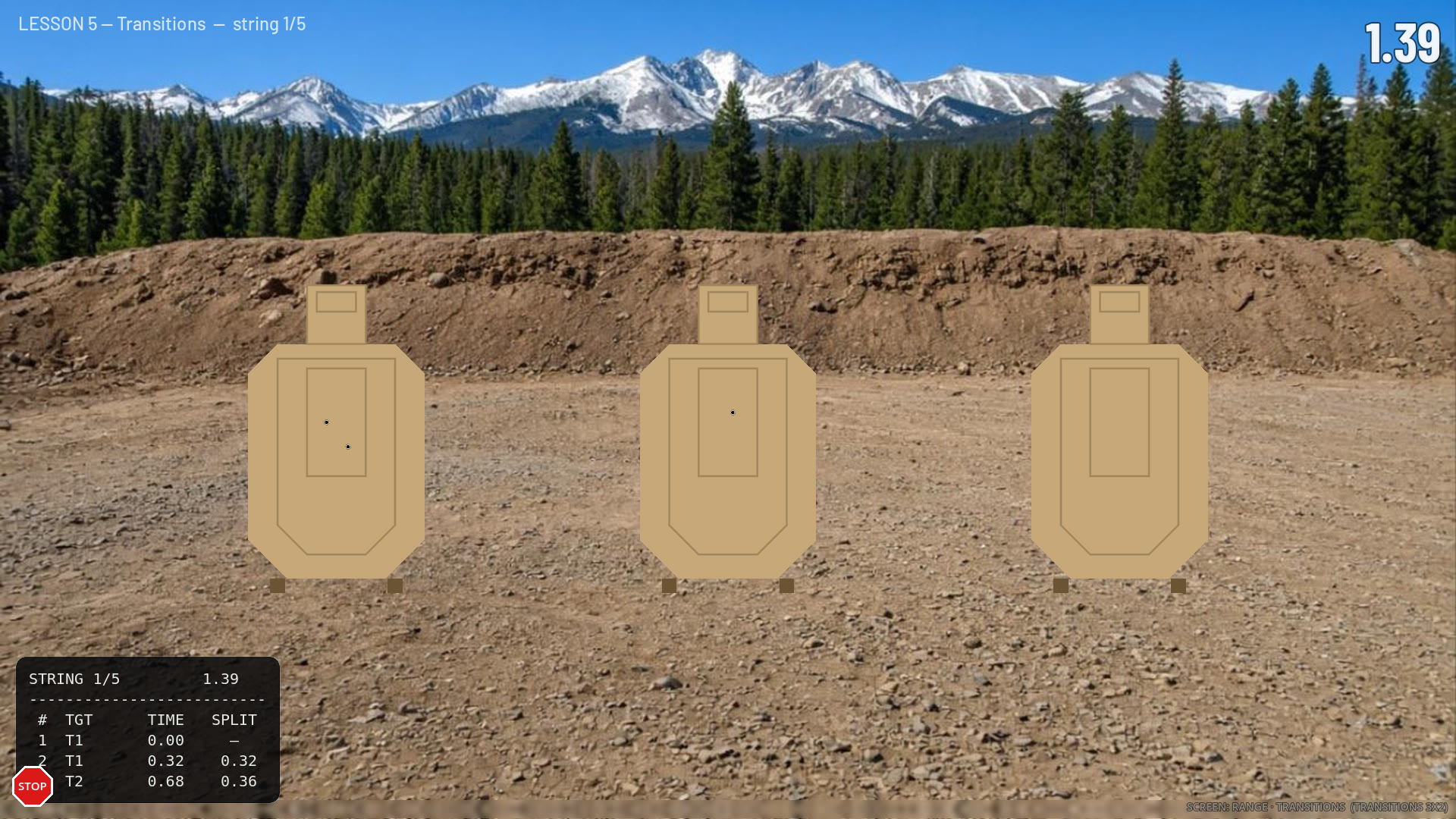
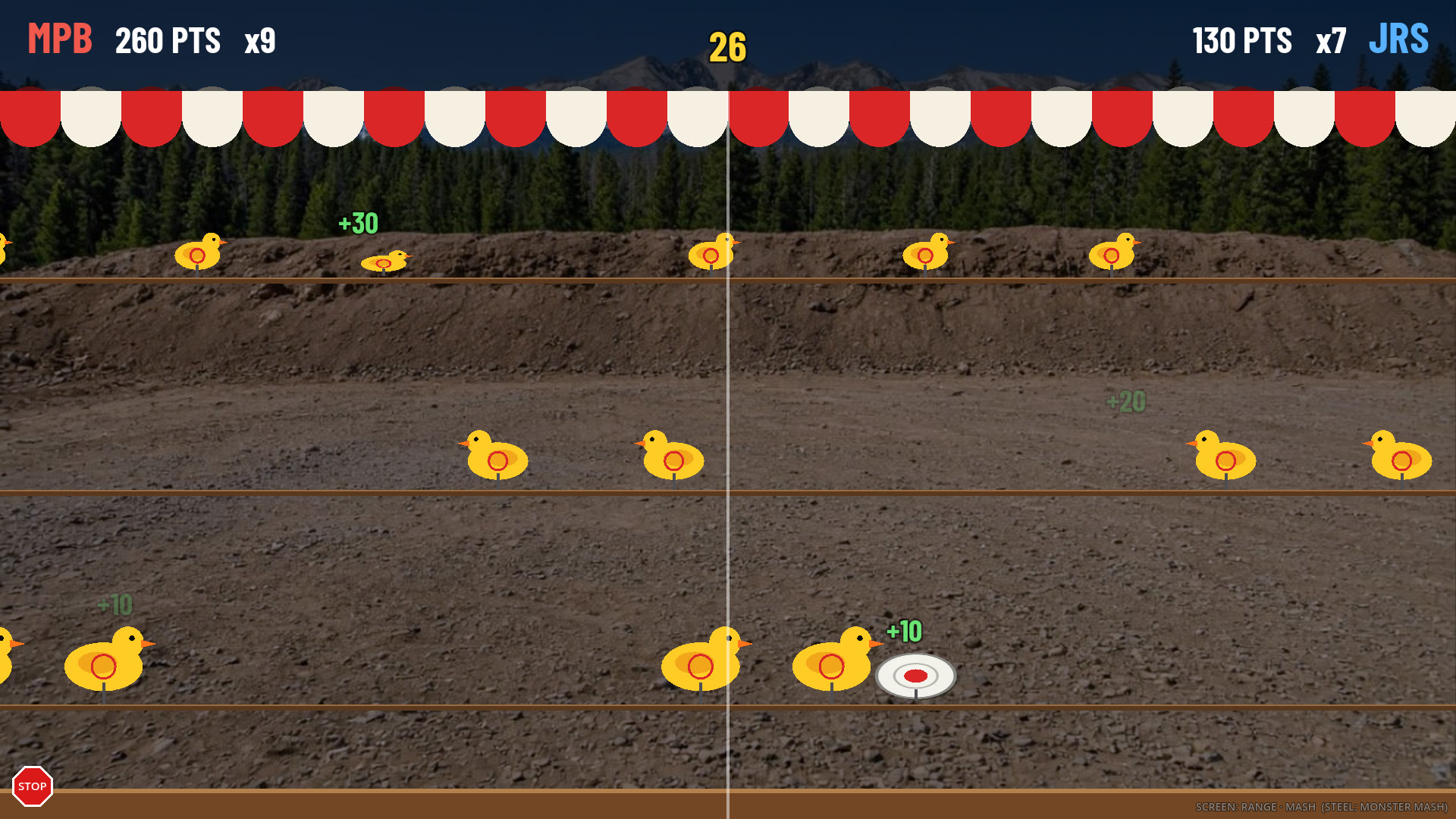
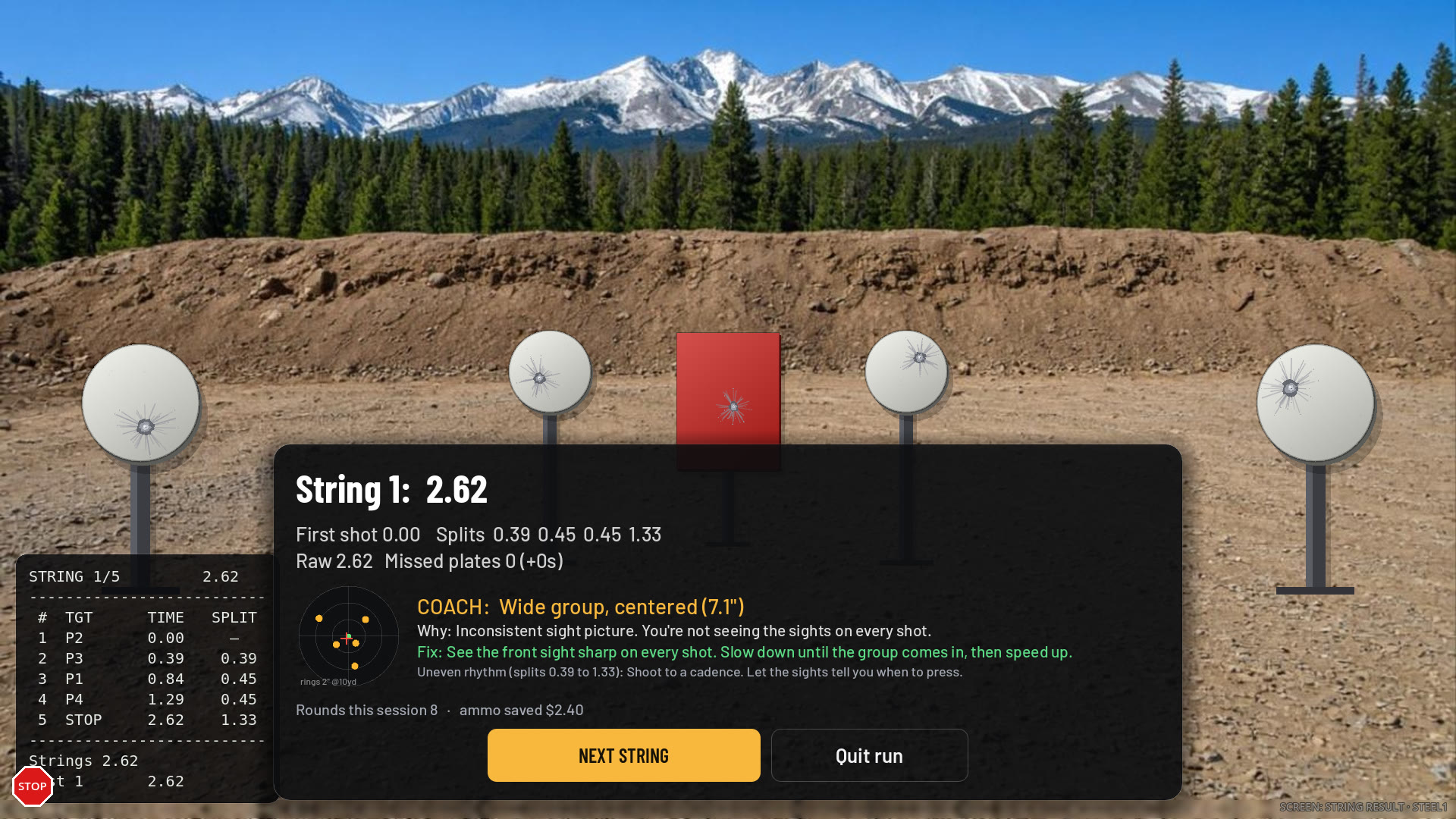
A 2D dry fire simulator draws flat targets on your screen: steel plates, paper targets, poppers. No scenery to look at, no camera moving through a world. A 3D simulator renders an environment (a range, a shoot house, a street) and shows targets inside it with perspective, lighting and depth.
Both use the same basic pipeline. Your laser trainer or light gun "fires," the system detects where the shot landed, and the software scores it. The difference is what's on the screen while you're working.
What does the research say about realism and learning?
There's no published head-to-head study of 2D vs 3D for pistol dry fire yet. But there's a large body of research on simulator fidelity (how realistic a simulator is) and whether realism improves skill transfer. The findings are consistent: more realism usually doesn't buy more learning.
- A review of 17 randomized studies on procedural skill training found that low-fidelity simulators were not inferior to high-fidelity simulators in 15 of the 17 studies.[1]
- A review in Medical Education that compared high- and low-fidelity simulation on real clinical performance found only a minimal relationship between fidelity and transfer of learning.[2]
- A meta-analysis of simulators for technical troubleshooting found no fidelity level was universally better. Higher fidelity helped transfer mainly for trainees who already had high skill.[3]
These studies come from medicine and technical training, not shooting. But the principle carries over: what transfers is practicing the right task with good feedback, not how lifelike the scene looks.
Why does visual clutter slow learning down?
Cognitive load theory explains it. Working memory is small. Everything on the screen competes for it. Researchers split mental load into the task itself (intrinsic load) and everything that isn't the task (extraneous load). Novices are most at risk of overload, and reducing total load leads to better performance and more efficient learning.[4]
Realistic detail is a known source of extraneous load. Learners have to sort which details matter and which don't, and that sorting costs effort.[5] Even purely decorative animation has been shown to hurt recall in a controlled study.[6]
In shooting terms: your eyes have one job. Find the target, put the front sight on it, call the shot, move. Trees, shadows, buildings and camera motion are all things your brain has to filter before it can do that job.
What actually transfers from the screen to the range?
The skills that win matches and save lives are mostly visual and motor:
- Finding the target fast
- Getting a usable sight picture
- Pressing the trigger without disturbing the sights
- Transitioning to the next target and stopping the gun on it
- Drawing and reloading on a clock
All of these train fine on a flat target. What matters is that the target is the right size, the timing is real, and you get honest feedback on every rep: time, splits and where the hit landed.
Why does true size matter more than 3D graphics?
Your sight picture depends on angular size: how big the target looks from where you stand. A 12-inch plate at 10 yards looks a certain size behind your front sight. If the plate on screen is too big, every rep is easier than the range. Too small, and you're training the wrong sight picture.
A 2D target can be drawn at exactly the right size for your screen and viewing distance. A 3D engine renders through a virtual camera whose field of view rarely matches your actual screen size and how far you're standing from it, so a "10-yard" target in a 3D scene often isn't 10 yards to your eyes. See True-size targets: how to scale dry fire targets on a TV or projector for the math.
Simpler scenes are also easier to render at a high, steady frame rate, which keeps hit feedback tight.
When is a 3D simulator worth it?
3D isn't useless. It earns its place when the skill you're training depends on depth or context:
- Targets moving toward or away from you
- Moving between positions, around barricades or through rooms
- Shoot/no-shoot decisions that depend on a scenario
- Use-of-force and judgment training
The troubleshooting meta-analysis above found fidelity helped mainly trainees with high prior skill.[3] That fits what coaches see: lock in the fundamentals on clean targets first, then add complexity.
How does REPS apply this?
REPS is built 2D on purpose:
- Clean backgrounds with no scenery competing for your eyes
- Every target drawn at true size for your screen and viewing distance, with an actual-size preview
- Real scoring: Steel Challenge times, USPSA hit factor, IDPA time-plus
- Background choice logged per string, so clutter vs. learning can be measured instead of guessed
Train the fundamentals where your eyes have one job. Then go prove it at the range.
Questions people ask
Is 3D dry fire training bad?
No. 3D is useful for movement, depth and scenario training. For core pistol fundamentals, research on simulator fidelity suggests a clean 2D target at true size trains them just as well, with less visual load.
Is 2D dry fire good for beginners?
Yes. Beginners are the most sensitive to cognitive overload, so a clean target with one clear task (sights, trigger, timer) is the best place to start.
Do I need VR for dry fire training?
No. VR adds immersion and depth, but draws, sight pictures, trigger control, transitions and reloads all train on a flat screen with a real gun or training pistol in your hands.
Does 2D work for Steel Challenge practice?
Yes. Steel Challenge is fixed targets at known distances, which maps directly onto true-size 2D plates with a real shot timer.
Sources
- The effect of simulator fidelity on procedure skill training: a literature review — International Journal of Medical Education (PMC)
- The minimal relationship between simulation fidelity and transfer of learning (Norman, Dore & Grierson, 2012) — Medical Education (PubMed)
- The effect of simulation fidelity on transfer of training for troubleshooting professionals: a meta-analysis (Doozandeh & Hedayati) — IISE Transactions on Occupational Ergonomics and Human Factors
- Reducing cognitive load in VR simulator training — Advances in Simulation
- Realism, cognitive load and learning (Skulmowski) — Cognitive Processing (Springer)
- Decorative animations impair recall and are a source of extraneous cognitive load (Pink & Newton, 2020) — Advances in Physiology Education
About the author
Matt Burkett, Founder of REPS
- 150+ state, national and world titles
- Author of the Practical Shooting Manual
- Expert on History Channel's Top Shot
- 20 years with virtual firearms simulation companies